A newer engineer is at your desk with a drawing in his hand. The frame is specified in 3/8 plate. The calculation on the same job shows 1/4 would pass. He wants to know why.
The drawing is in the folder. The calculation is in the folder. The person who can tell him why is retiring in March.
The usual plan is a long write-up and an exit interview before he goes. The files look decent, so the job feels like getting what's in his head onto paper.
But the drawing and the calc aren't what's missing. What leaves is the reason behind the number, and the map of where that reason lives. That is what people mean by tribal knowledge in manufacturing.
You're not the only one feeling the clock. Isaac Nesbitt, writing about a 30 year veteran's retirement, put the timing this way: "The best time to write down thirty years of institutional wisdom was five years ago. The second best time is today." The timing is the easy part to agree on. The harder question is what to write down.
LinkedIn post
Open on LinkedInLoading the embed contacts LinkedIn. Show the post here when you are ready.
What is tribal knowledge in manufacturing?
Tribal knowledge in manufacturing is the know-how a shop runs on that lives with people, not in a system: the reasons behind choices, and where to look for them.
Teams sometimes call this institutional knowledge or undocumented know-how. "Tribal knowledge" is the phrase people actually search, so we use it here, then say know-how. The idea is the same either way.
You're not behind for running on it. A national flood barrier in the Netherlands, documented by engineers, ran into the same gap. The handoff is also large. Deloitte and The Manufacturing Institute project that US manufacturing will need about 3.8 million new workers from 2024 to 2033, with 2.8 million of those jobs opening through retirements. It's a US projection from a survey of more than 200 manufacturers and government labor data, not a count of who has already left.
Aren't the drawings and files enough?
Usually the drawings and calculations are already there. What is often missing is the assumptions behind the numbers.
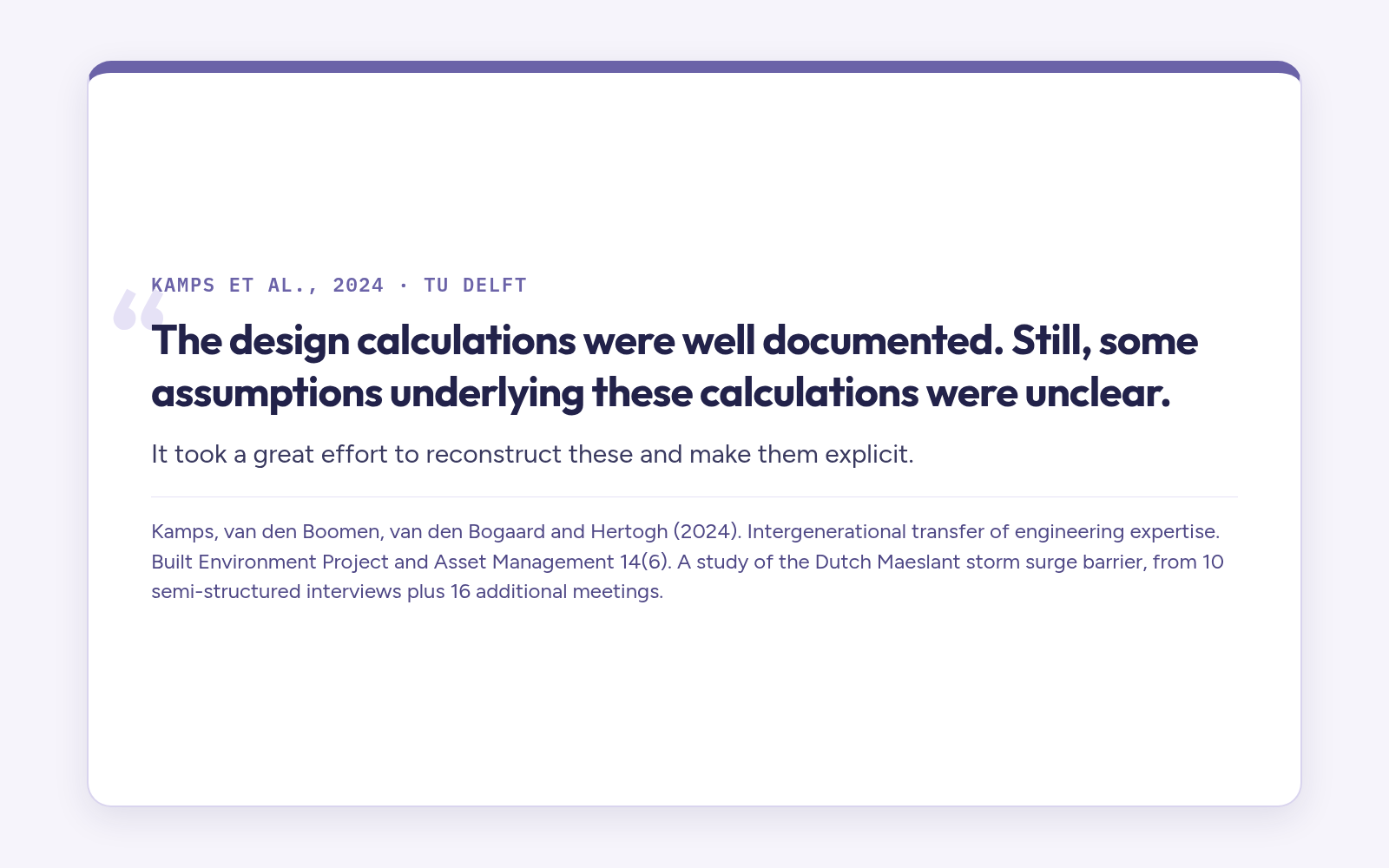
When engineers revisited the design of the Dutch Maeslant storm surge barrier years after it was built, a TU Delft study found this: "the design calculations were well documented. Still, some assumptions underlying these calculations were unclear." The authors wrote that important design decisions had been made based on the tacit engineering knowledge of the barrier's designers, and "it took a great effort to reconstruct these and make them explicit" (Kamps, van den Boomen, van den Bogaard and Hertogh, 2024).
If a well documented national flood barrier hit that wall, it's probably not just your filing system.
Why do senior engineers know where everything is?
They are the map. They know which folder, which engineering change, which supplier email, and which person to ask.
The same study put it plainly: "More than 25 years after completion, the few remaining engineers involved with the Maeslant Barrier's design still act as an important guide to the barrier's engineering documentation." Senior people are the index to the files. That is also why "Shortcomings in documentation will go unnoticed until a new replacement effort gets underway."
This matters for every new hire, and for every tool you point at those files. An answer is only as good as the documents someone knew to open.
Here's one question, and the four places a veteran actually checks. It's an illustrative example, not from a real job.
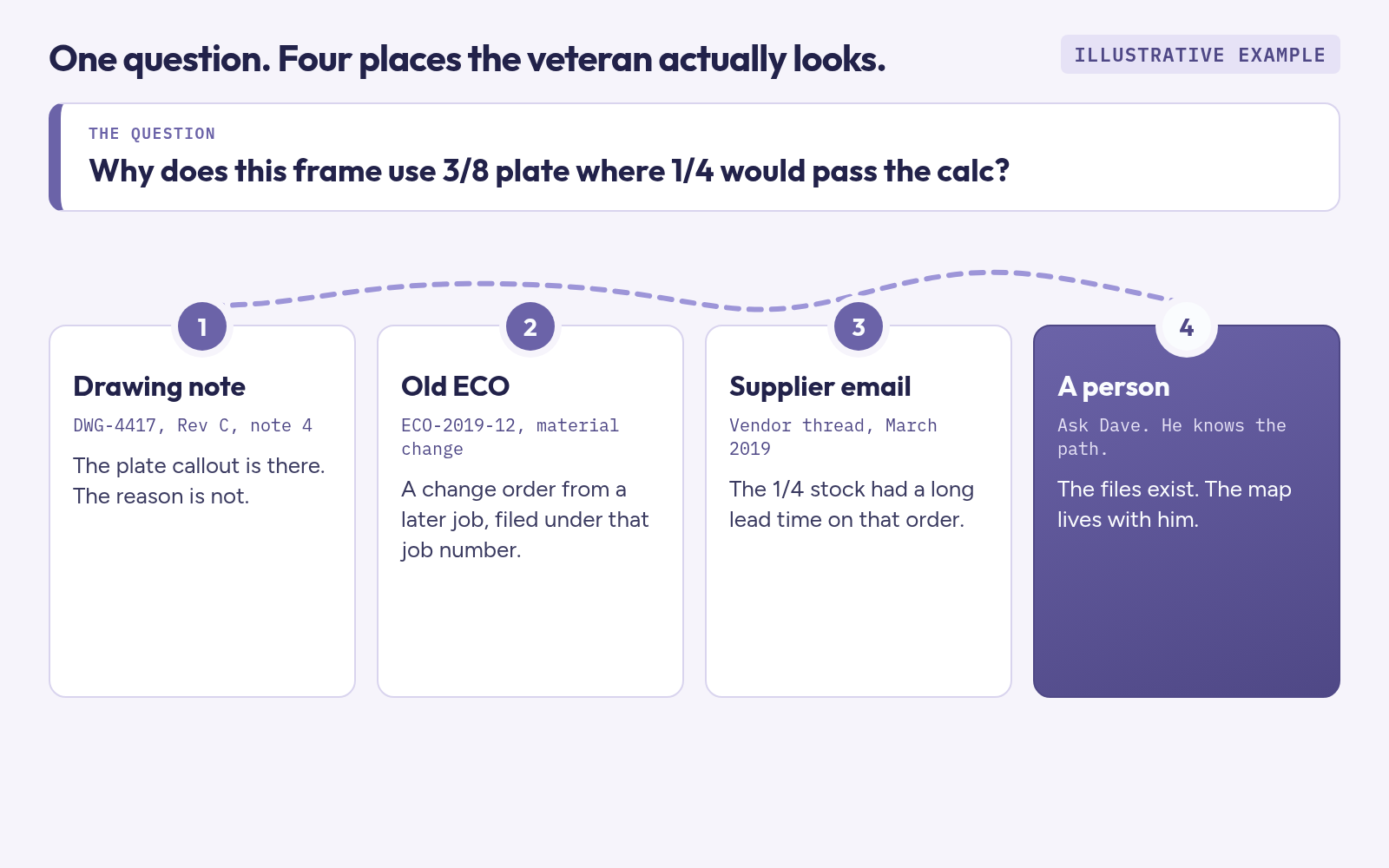
In a case like the 3/8 plate, the reason usually isn't in the calc at all. It might be weld distortion on thinner plate, a stiffness or vibration limit the calc never checked, a customer who rejected a flexing frame years ago, or a supplier who stocks 3/8 and not 1/4. Each one is a single sentence. None of them is written on the drawing.
Your shop also has one advantage the barrier engineers didn't. Their big redesigns come decades apart, so the people who know the reasons are rarely around for the next one. In custom work, the same kinds of choices come back every few months. That makes the reasons cheap to catch, as long as someone writes them down while the job is open.
How do you capture tribal knowledge before someone retires?
Aim at the why and the map, not a brain dump. Three moves will get you further than an exit interview that tries to write everything down.
The write-up before someone leaves isn't wrong. It's just usually aimed at the wrong target.
- Record reasons on live jobs. One line of "because" on each non-obvious choice, while the job is still open. A note written in the moment is easier to trust than a recap written in the last week.
- Have the veteran narrate where they look, while answering a real question. Sit with a question that has already come up, and write down the path: the folder, the change order, the email, the person.
- Pair on real work. The study's authors put it this way: tacit skills "transfer best through mentored performance of authentic tasks."
There is an honest limit. Mentoring only holds if the knowledge stays in use. Retired engineers in that study believe that "the people they have mentored have forgotten a lot after years-long gaps in knowledge use." A write-up that never gets opened, and a mentee who never meets the same decision again, both fade.
Test it yourself
Pick three non-obvious choices on a current drawing. Give a newer engineer 10 minutes each to find the reason in writing. Then ask your senior engineer the same three and note where they looked.
Write down three things for each choice: the choice, whether the newer engineer found the reason, and where the senior engineer looked. If the newer engineer finds the rule but not the reason, that is a why gap. If they cannot find the file the senior engineer opened in a few seconds, that is a map gap.
Close each gap where the next person will look, not in a separate document. For a why gap, add one "because" line to the drawing notes or the job folder. For a map gap, add a pointer: "reason is in ECO 214" or "ask the supplier email thread from March". Three choices, a handful of lines, done this month.
Start with choices that are not explained by the calculation alone: a thicker plate, a supplier who isn't the default, a note that survived a revision. Don't name the folder. The test is whether someone else can find the why without already knowing where it lives.
When you're done, you'll have a short list. That's the work to do while the veteran is still here.
HarV is built to keep the why and its source next to the files, so the next person can ask the question the veteran used to answer. If you'd like to try that on one job folder, we're happy to run it with you.
Sources
Deloitte and The Manufacturing Institute (April 2024). Taking charge: Manufacturers support growth with active workforce strategies. https://themanufacturinginstitute.org/wp-content/uploads/2024/04/Digital_Skills_Report_April_2024.pdf . US projection based on the 2024 Deloitte and Manufacturing Institute Talent Study (a survey of more than 200 US manufacturers) and Bureau of Labor Statistics data.
Kamps, M., van den Boomen, M., van den Bogaard, J., Hertogh, M. (2024). Intergenerational transfer of engineering expertise: knowledge continuity management in storm surge barrier engineering. Built Environment Project and Asset Management 14(6), 874 to 891. https://doi.org/10.1108/BEPAM-10-2023-0179 . Qualitative case study: 10 interviews plus 16 follow-up meetings at the Dutch storm surge barriers.
Cover photo: Pexels. Illustrations: HarV.
Frequently asked questions
What is tribal knowledge in manufacturing?
Tribal knowledge in manufacturing is the know-how a shop runs on that lives with people rather than in a system. It is usually the reasons behind design and process choices, and the map of which file, which change order, or which person holds them.
Is it OK to say tribal knowledge?
Many people still say tribal knowledge, and it is the most common search term for the idea. Others prefer institutional knowledge, undocumented know-how, or just know-how, because "tribal" can feel like the wrong word. The meaning is the same: knowledge that lives with people and is easy to lose when they leave.
How do you capture tribal knowledge?
Capture the why and the map, not a full brain dump. Write a short "because" on non-obvious choices while the job is open, have the veteran narrate where they look while answering a real question, and pair on live work. Mentoring works best on real tasks, and it fades if the knowledge sits unused.
What knowledge is lost when employees leave?
When a senior engineer or machinist leaves, the drawings and calculations usually stay. What often leaves is the assumptions behind the numbers, and the map of where to find them: which folder, which change, which email, whom to ask.