You've done this before. A question comes up at the start of a new job, and something in the back of your head says you've seen it. You know the answer exists. You even remember the meeting where it got written down. You just can't place it: which job, which folder, which year.
Now picture the newer engineer at the next desk. They hit the same question, but they don't get that tug at all. They can't ask about the lesson, because they don't know there is one.
So the lesson sits in the lessons learned database, safe and complete, and the same problem shows up again two jobs later.
You weren't careless
If your team wrote the lesson down and still repeated the mistake, that isn't carelessness. It's how lessons learned systems usually behave, even at NASA, with a required system.
Most shops do the right things. They hold the end of job meeting. They fill in the template. They save it where it belongs. Then the next job starts, and nobody opens it.
NASA's Office of Inspector General looked at exactly this in 2012. It surveyed project managers for 28 of NASA's 32 science and space flight projects launched between January 2005 and May 2011. It found "only 16 of the 28 (57 percent) project managers indicated that they used LLIS during the project acquisition life cycle" (NASA OIG, IG-12-012). LLIS is NASA's Lessons Learned Information System, the agency's own lessons database.
That's an agency full of careful engineers, with a policy behind the system. If it happened there, it isn't your team.
Why a lessons learned database stays closed
A lessons learned database stays closed because of how lessons are filed, not because people don't care. Three things get in the way, and none of them is laziness.
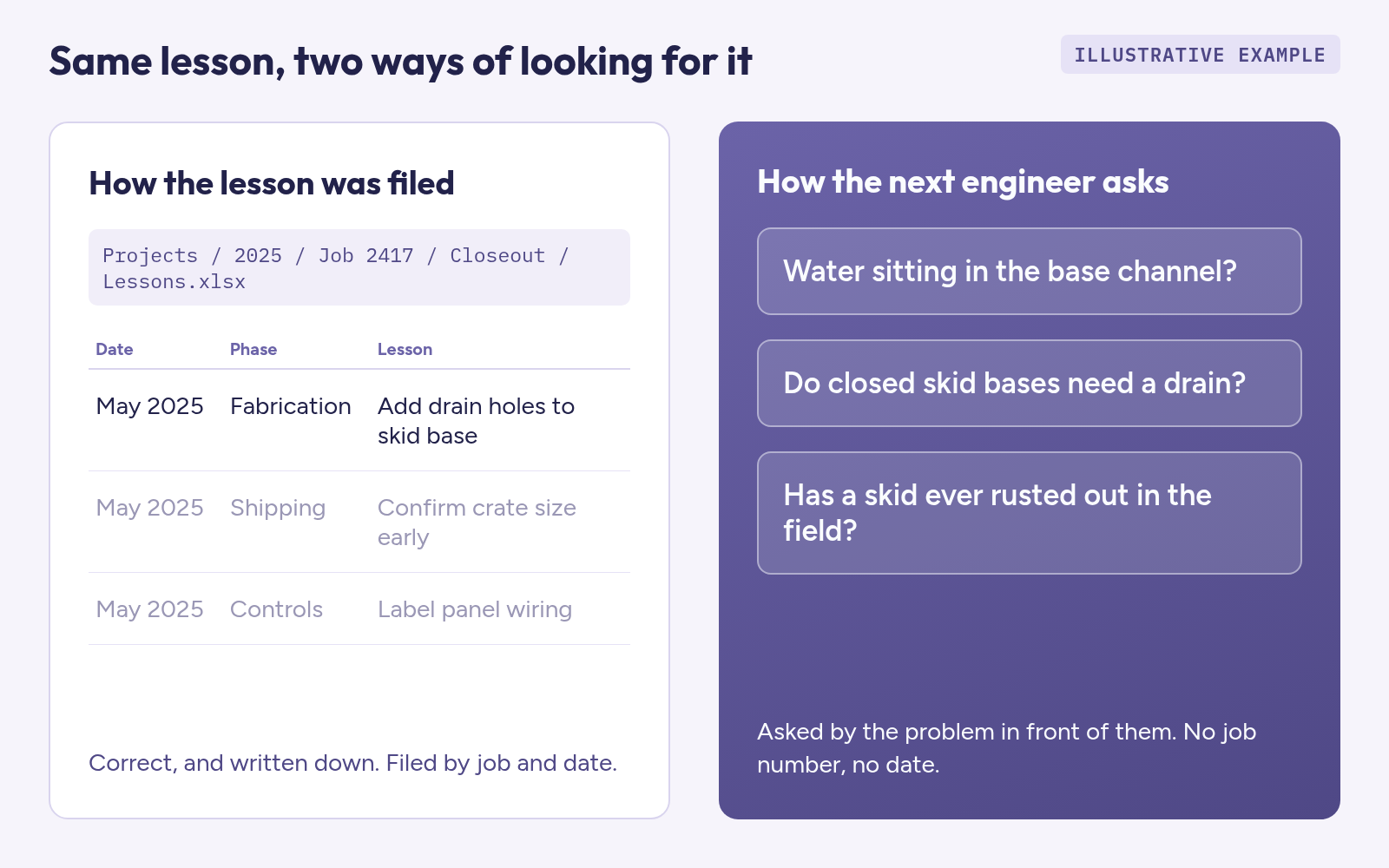
It's filed by project. People search by problem. A lesson usually lives under a job number and a date. But nobody starting a new job thinks "let me check the closeout file from job 2417." They think "do closed skid bases need a drain?" The lesson and the question point at the same thing from two different doors.
The reason gets shrunk to one line, and the proof stays in email. By the time a lesson reaches the log, it's often a short rule: "add drain holes to skid base." The why behind it, the service report, the photos, the reply from the field, stays in an inbox or a project folder. A rule without its reason is easy to skip. (That missing why is what we called design intent.)
Nobody checks before deciding. Decisions happen in a design review, at a desk, on a call. Opening the log is a separate trip, and it's one nobody remembers to make in the moment. In 2002 the US Government Accountability Office reviewed NASA and found that "lessons are not routinely identified, collected, or shared by programs and project managers," with barriers including "the lack of time to capture or submit lessons and a perception of intolerance for mistakes" (GAO-02-195).
Here's one lesson seen both ways: how it was filed, and how the next engineer would actually ask for it.
What do teams that make lessons stick do differently?
They put the lesson where the next job starts: in the checklist, the standard or the template people already open. A lesson that waits to be looked up usually isn't.
Think about what your team opens at the start of every job. The design review checklist. The detailing standard. The quote template. Those get opened because the work can't move without them. A lesson written into one of them gets read at the moment it matters, by someone who never had to know it existed.
Not every lesson belongs there. A checklist with two hundred lines stops being read. Put in the lessons that change a decision, and keep the rest as cards.
Research on project learning points the same way. In a survey of project managers, Terry Williams opened with this: "The need to learn from one project to the next is clearly of vital importance, but is often neglected" (Williams, 2008, IEEE Transactions on Engineering Management). Projects are temporary, so the team that learned the lesson breaks up before the next job starts.
One steel detailing manager did exactly this. He built a Lessons Learned section into his team's detailing standard, so every revision carries the mistakes forward. His line: "Standards are not built from theory. They are built from failure."
LinkedIn post
Open on LinkedInLoading the embed contacts LinkedIn. Show the post here when you are ready.
A lesson the next person can find
A findable lesson has four parts: the decision it applies to, what happened, why, and where the proof lives. Write it so the next person can match it to their problem without knowing the job.
- The decision it applies to. Write it in the words someone would use before making that decision again, not the job name.
- What happened. One or two plain sentences.
- Why. The reason, not just the rule. This is the part that usually gets cut.
- Where the proof lives. The report, the photos, the drawing note. Name it so someone can open it.
Here's the skid base lesson from earlier, written as a card. It's an illustrative example, not from a real job.
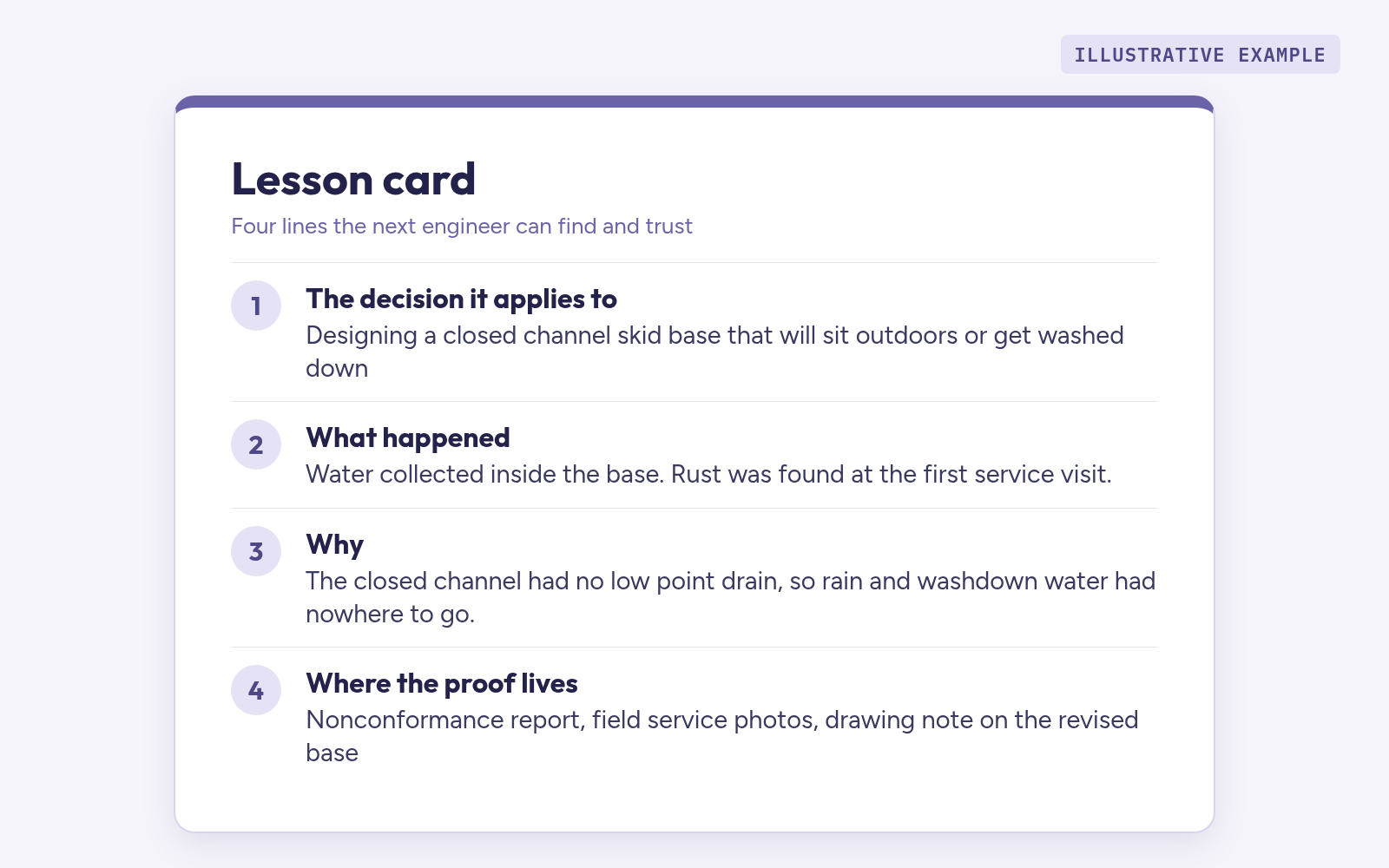
Notice the first line. Someone designing a skid base next year will think in those words. Nobody will think in the job number.
Where HarV fits
HarV is built to bring a past decision back with its files when someone asks about the problem in their own words. It sits beside your lessons meeting, your checklist and your PLM, not instead of them.
In our last post we talked about AI that reads the files your team already has and brings the source back with the answer. Lessons are a good test of that, because the question and the filing rarely match.
Here's a real question asked against our demo project, Voss Kinematics, which uses fictional data: why was the J2 drive torque capacity on NEMO increased, and what earlier analysis was the original sizing based on? The answer cites ECO-2026-014 and opens the source document beside it. It also says plainly: "The records do not show which analysis the original 24 N m figure came from."
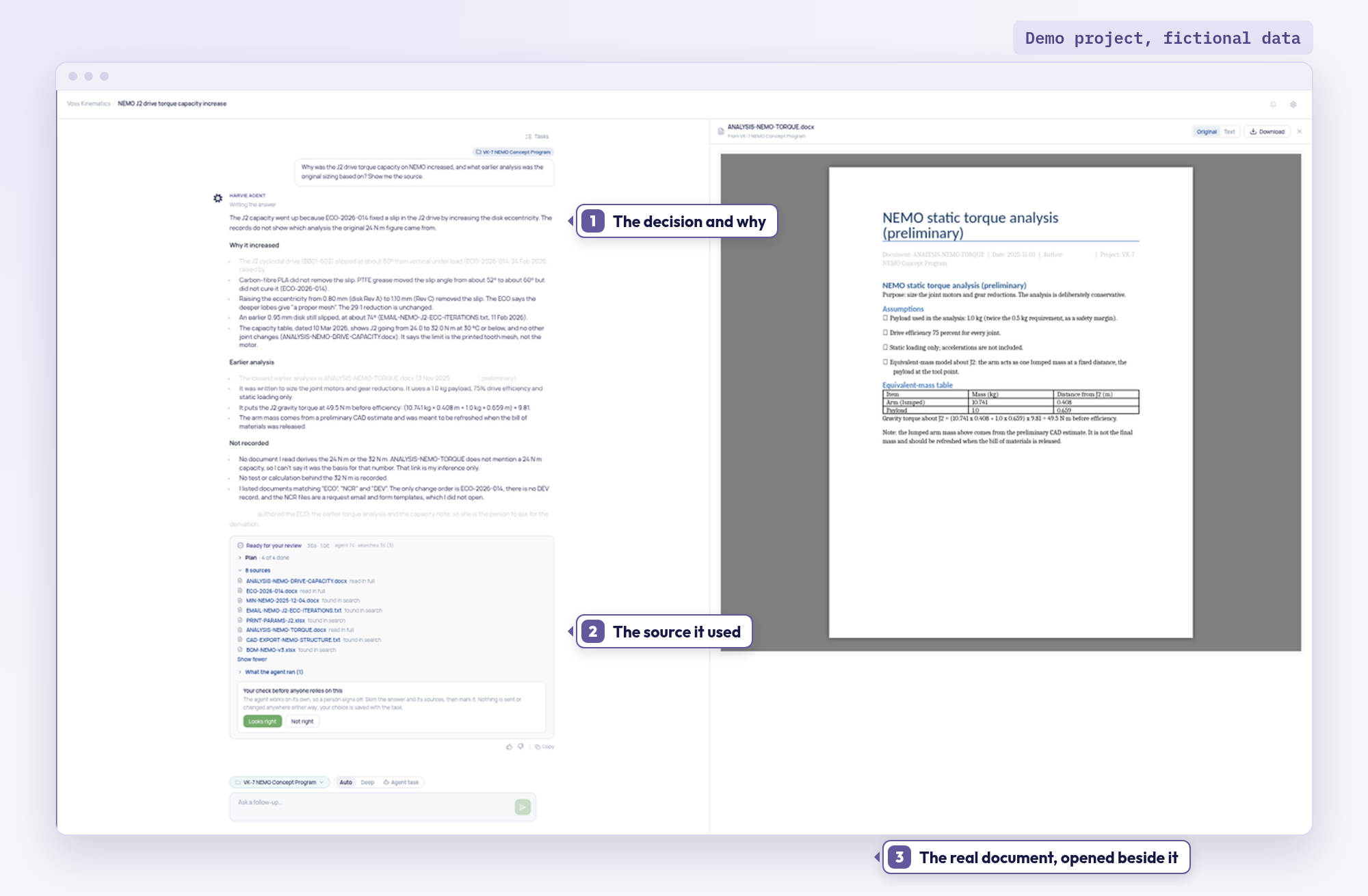
That gap is the honest limit: it only finds what the team has uploaded. If the reason lives only in someone's head, or in a file nobody added, it can't bring it back. And it won't hold the lessons meeting for you. The meeting, the checklist and the card still do that work.
Test it yourself
Give a newer engineer only the problem, not the job name, and time how long it takes them to find the lesson and its reason. Fifteen minutes tells you whether your lessons can be found.
Pick one lesson from a job at least six months old. Tell a newer engineer only the problem, as they'd meet it: "We're about to design a closed skid base that sits outside. Anything we should know?" Don't name the job. Start a timer.
Stop when they find the lesson and the reason behind it, or at fifteen minutes. If they find the rule but not the why, note that too.
If they can't find it, the lesson isn't lost. It's filed where the question doesn't look. Rewrite that one lesson as a card and put it in the checklist. That's a good Monday.
If you'd like to see how HarV handles the same question on your own files, we're happy to run it with you. It only knows what you give it, so start with one job folder.
Sources
- NASA Office of Inspector General, Review of NASA's Lessons Learned Information System, IG-12-012 (March 2012). https://oig.nasa.gov/wp-content/uploads/2024/02/IG-12-012.pdf . Scope: project managers for 28 of NASA's 32 science and space flight projects launched January 2005 to May 2011. Quote verified in the PDF text, 2026-11-02.
- US Government Accountability Office, NASA: Better Mechanisms Needed for Sharing Lessons Learned, GAO-02-195 (January 2002). https://www.gao.gov/products/gao-02-195 . Quotes verified on the GAO report page Highlights, 2026-11-02.
- Williams, T. (2008). How do organizations learn lessons from projects, and do they? IEEE Transactions on Engineering Management 55(2), 248 to 266. https://doi.org/10.1109/TEM.2007.912920 . Abstract line only, verified 2026-11-02.
Cover photo: Pexels. Product visual: HarV demo project with fictional data. Illustrations: HarV.
Frequently asked questions
What is a lessons learned database?
A lessons learned database is a shared record of what a team learned on past projects: what happened, why, and what to do differently. It only helps if the next person can find the right lesson when they face the same decision.
What is the purpose of a lessons learned?
The purpose of a lessons learned is to stop the next project from repeating a known problem. It captures a decision, what happened, the reason and where the proof lives, so someone who wasn't there can use it.
Why are lessons learned important?
Lessons learned are important because project teams break up when a job ends, and what they learned leaves with them unless it's written down where the next team will look, such as a checklist or a design standard.
What is the best way to share lessons learned?
The best way to share lessons learned is to put them where the next job starts: a design review checklist, a detailing standard or a project template. Write each one by the problem it solves, not by the job it came from.