Pick any part in your shop and ask why it looks the way it does. The answer is rarely in one place. The drawing shows the new dimension. An email thread holds the back and forth about it. A test report holds the result that settled it. A supplier note explains what they could actually make. And the judgment call that tied it all together lives in the head of the person who made it.
No single file holds the whole story. That isn't a sign of a messy shop. It's how engineering decisions get made: across conversations, tests and suppliers, with each step leaving its piece somewhere different.
If you ran the two-year test from our last post, you've felt this. You picked a change, timed how long it took to find out why, and most of that time probably went to hopping between those places: the shared drive, your inbox, a binder, a colleague's desk. That hopping is exactly where AI for engineering documentation should help. It's also why the first try often disappoints.
Why the first try feels underwhelming
So you try the obvious thing. You open a chatbot, paste in the PDF, and ask why the change was made. The answer comes back fast, well written and confident. It might even be right. But it can only work from the one file you gave it, and it doesn't show where its answer came from. A confident answer with no source can't be checked, so you end up doing the dig anyway.
The worst part is you cannot give AI what you don't even know you don't know. You paste the file you know to look for. The reason that matters is often sitting in a file you never thought to open: a test report from another project, a supplier email from three years ago, an NCR someone filed and moved on from.
That isn't you using it wrong. Most chatbots are set up for one person and one file at a time, and engineering knowledge isn't stored that way. A study that followed 78 design engineers for 20 working days found they spent 55.75% of their working time on information work: searching for information, receiving it and passing it on (Robinson, 2010, JASIST). If the dig feels like a second job, you're not alone, and the numbers agree.
What AI for engineering documentation should actually do
The pasted PDF chatbot was only the introduction. This post is about the next step, retrieval: AI that reads what your shop already has and brings the source back with the answer. Later in this series we'll get to agentic AI, the kind that takes actions on your behalf. (If you're just joining, our first post covers what AI does beyond chat.)
Done well, retrieval does three things:
- Reads across everything your team has uploaded, not just the one file you remembered to paste.
- Answers the question you actually asked, in plain words.
- Shows where each part of the answer came from, so you can open the source and check it in a minute.
Here is the same question asked both ways, once with a single pasted file and once across a shop's files.
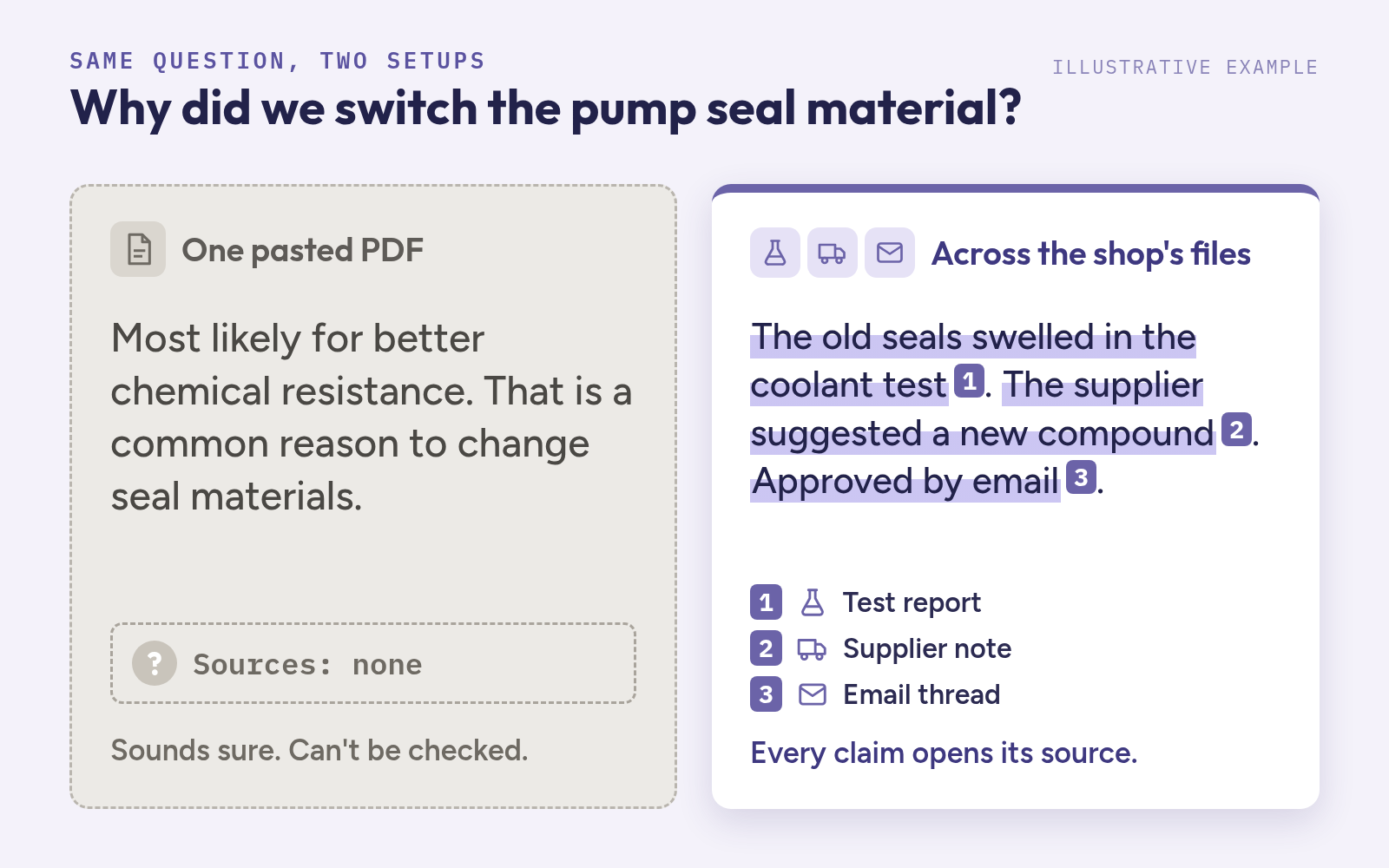
The left answer isn't careless. One PDF is all it has, so it fills the gap with what's generally true. The right answer is built from three files, and every claim points to its source. You don't have to trust it. You can check it.
Researchers named this gap early. The 2020 paper that introduced retrieval-augmented generation, the approach behind many "AI that reads your documents" tools, noted that for large language models "providing provenance for their decisions and updating their world knowledge remain open research problems" (Lewis et al., 2020). Their answer was to have the model look up real documents first and write its answer from them. In plain terms: look it up, then answer, and keep the trail.
What it unlocks
When the reason comes back with its source attached, a few everyday moments change:
- A repeat job starts from the last one's reasons. A customer wants a variant of an old job. Instead of starting from the drawing alone, you start from why it was built that way: what was tested, what failed, what the customer pushed back on.
- A supplier's "why is this note here?" gets answered in minutes. You get the reason and the report or email behind it, and you send the supplier the source instead of your best guess.
- A new engineer checks before simplifying a feature. That odd fillet or extra hole might be there for a reason. Asking first, and reading the test report that explains it, keeps a good idea from undoing an old lesson.
The bigger shift: the answer becomes shared. The next engineer isn't limited to what one person remembered to paste into a chat.
You're far from alone in feeling the cost when that trail is missing. When former aerospace design engineer Chris Canfield wrote that tribal knowledge may be the industry's biggest unspoken risk, hundreds of engineers reacted and commented with their own versions of it. His closing line will sound familiar to anyone who has run the two-year test: "someone will ask a question and no one will have the answer."
LinkedIn post
Open on LinkedInLoading the embed contacts LinkedIn. Show the post here when you are ready.
Where HarV fits
This is the part we build. HarV reads the files your team uploads, answers why a part or a decision is the way it is, and shows the source one click away. It sits beside your CAD, your drawings and your PLM, not instead of them. It doesn't write more documents. It helps you get the reason back from the ones you already have.
Here's what that looks like on a demo project with fictional data, where someone asked why a robot joint was redesigned and what caused its position jitter.
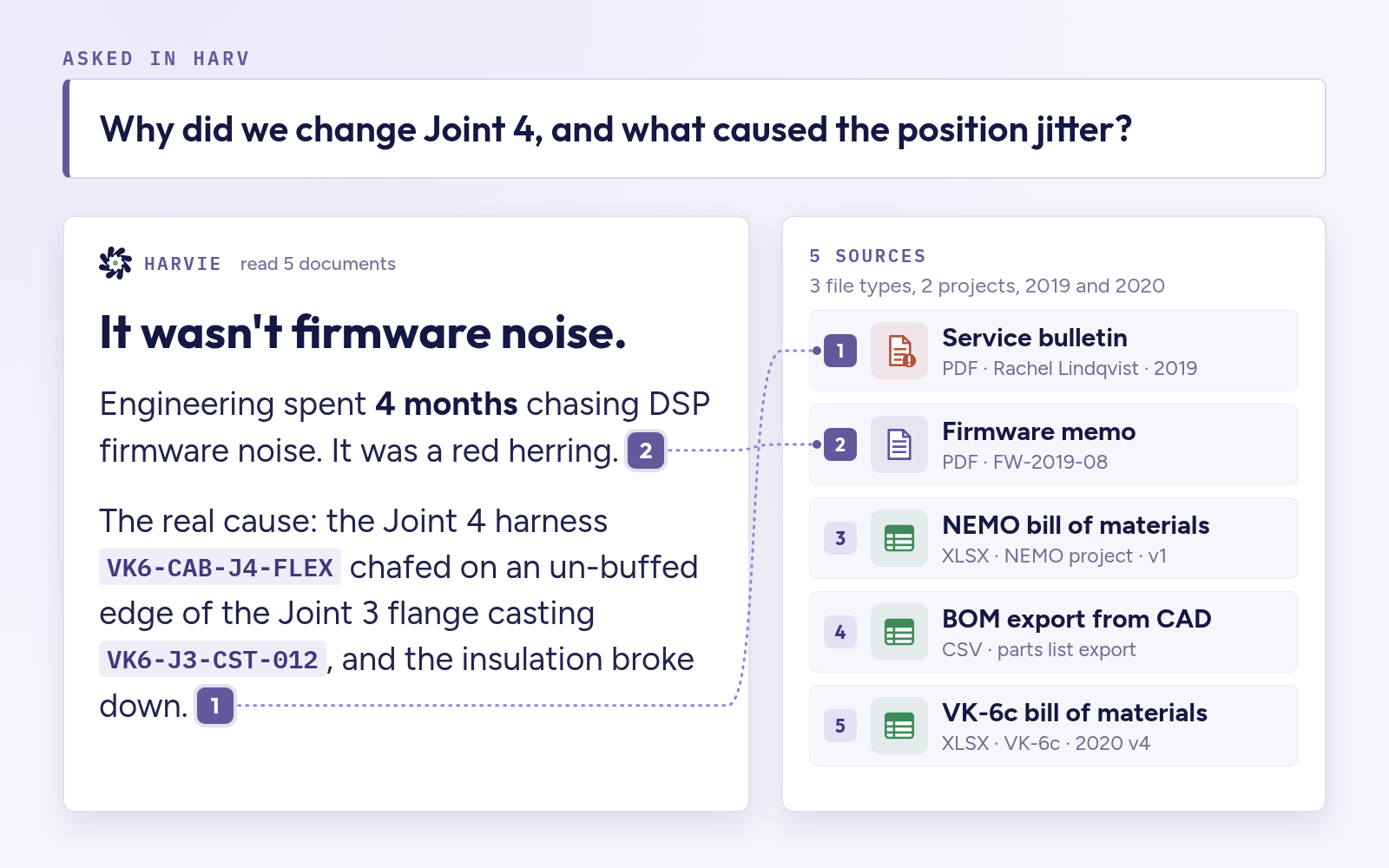
It wasn't firmware noise, even though months went into chasing it. The cable harness insulation was wearing against an un-buffed edge on the Joint 3 flange casting. HarV pulled that from five documents, a service bulletin, a firmware memo and three bills of materials, each a click away.
One honest limit: HarV can only find a reason someone wrote down somewhere. If the why only ever lived in a hallway conversation, no tool will find it. That's why the "Because:" line from the two-year test still matters.
Try this: five questions before you trust any AI with your documents
You don't need to trust the AI. You need to be able to check it. Before you hand any tool your documents, ask:
- Does every answer show its source, and can you open it? A citation on its own isn't proof. When Stanford researchers audited four popular generative search engines, they found that "a mere 51.5% of generated sentences are fully supported by citations and only 74.5% of citations support their associated sentence" (Liu, Zhang and Liang, 2023). That goes for every tool, ours included: the point of a source is that you can open it and read it yourself.
- Does it say "I couldn't find that" instead of guessing? A tool that admits a gap is more useful than one that fills it.
- Does it read across files, or only the one you paste? Remember the file you didn't know to look for.
- Can the next engineer ask the same question and get the same sources? If the answer lives in one person's chat history, it's still single player.
- Who can see your files, and where do they live? Ask before you upload, not after.
Then take the change from your two-year test, ask the tool why it was made, and time it against your dig. An answer with a source you can open is worth keeping. If it can't show one, you've found that out in ten minutes.
If you'd like a second pair of eyes, bring one past change to a 20 minute call and we'll look for the why together.
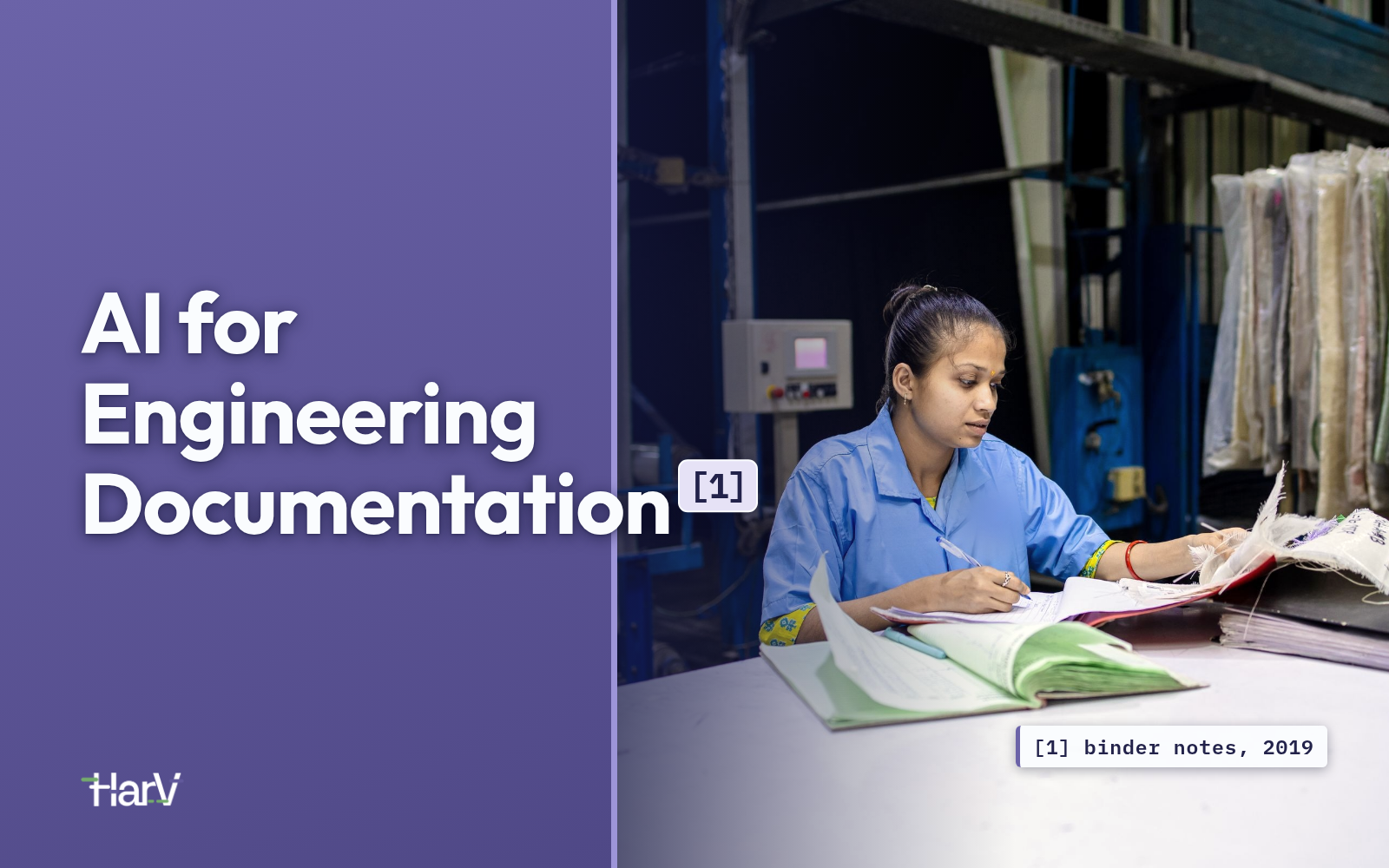
Cover photo: EqualStock IN (Pexels). Product visual: HarV demo project with fictional data. Illustration: HarV.
Frequently asked questions
What is the best AI for engineering documents?
The best one reads the files you already have, answers in plain words, and shows the source for every claim so you can check it. Use the five questions above to compare tools. If a tool can't show you its sources and let you open them, don't rely on it for engineering facts.
Can AI read my documents?
Yes. Many tools can read the PDFs, spreadsheets, exported emails and drawings you upload. The real differences are whether it reads one file at a time or across all of them, and whether it tells you where each answer came from. Check who can see your files and where they're stored before you upload.
Is there an AI that cites sources?
Yes. Tools built on retrieval look up documents before answering and can link each claim to the document it came from. Citations still need a quick check, because research has found that cited sentences aren't always supported by their sources. Open the link before you rely on it.
What is engineering knowledge management?
It's how an engineering team keeps what it knows findable and reusable: not only drawings and specs, but the reasons behind decisions, test results and lessons from past jobs. The hardest part has always been the why, because it's spread across emails, reports and people.