

Rev C is on your screen. The wall went from 3 mm to 4 mm, and the change note says "per engineering." Now someone wants to take it back to 3 mm to save weight, and you'd like to know why it moved before you say yes.
If you've ever typed "what is design intent" into a search bar at a moment like this, you're in good company. Our last post ended on this exact question: a macro or an AI agent can tell you what changed on Rev C, but neither can tell you why. This post is about that why, and about how many engineers are asking for it.
What is design intent in engineering?
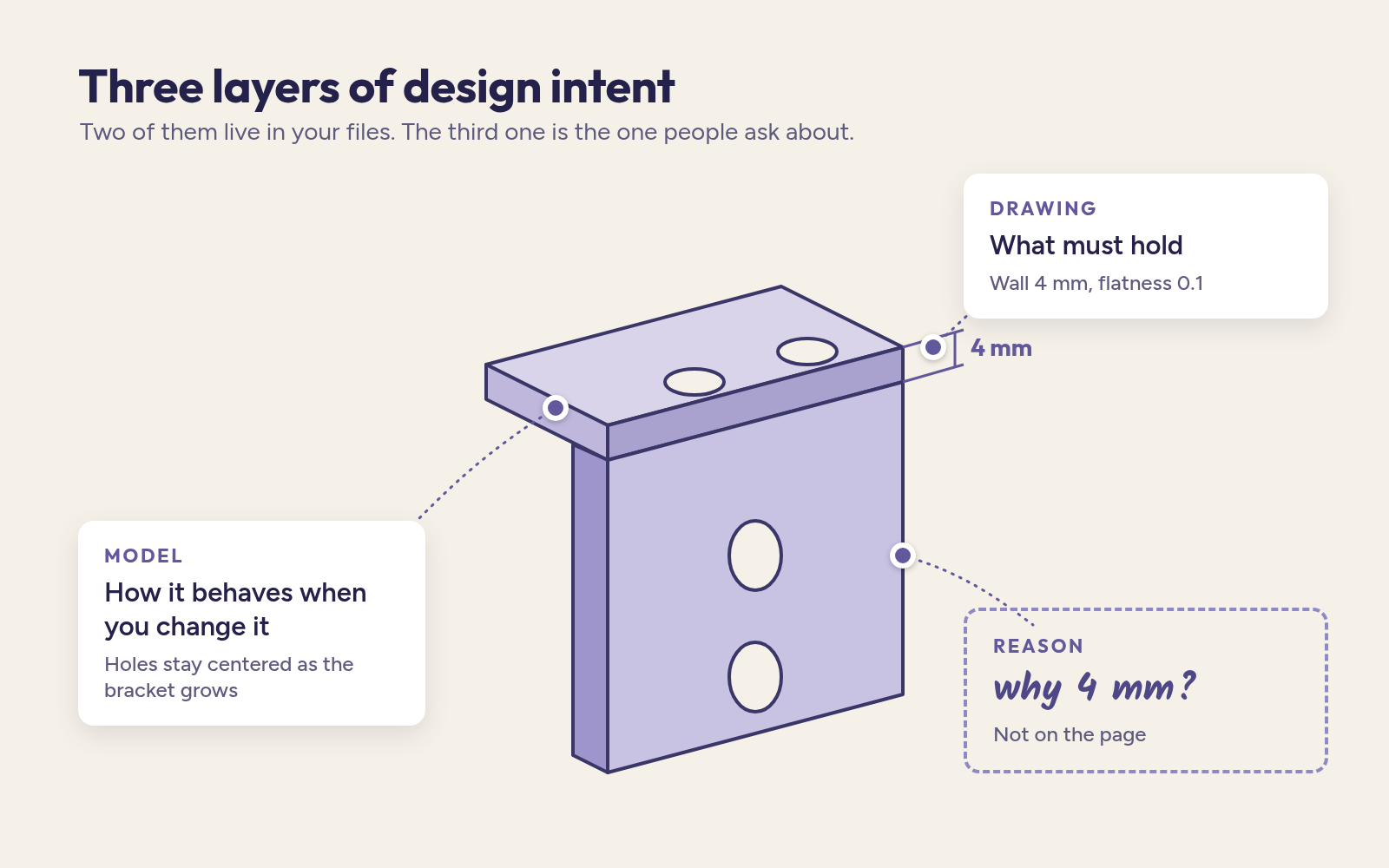
Design intent is the purpose behind a design: what each feature has to do, and why it is the way it is. It shows up in three layers.
In the CAD model, it's how features relate, so a change behaves. Center a hole on a plate and it stays centered when the plate grows.
On the drawing, it's what must hold: the 4 mm, the flatness callout, the datum that matters for fit.
Then there's the reason. Why 4 mm? A failed test, a customer request, a supplier who couldn't hold 3 mm? That layer rarely lives in the model or on the drawing, and it's the one engineers end up asking about.
It's not just your company
If finding that reason feels harder than it should, it isn't you, and it isn't your shop. It's a gap the whole field has written about for decades.
In 2010, Panos Papalambros, then editor of ASME's Journal of Mechanical Design, wrote that "even when you have a full geometric description of an object you may not know why something is designed to be like it is."
Researchers at the University of Cambridge studied this inside Rolls-Royce. In a 1996 study they found that "the majority of their information needs were met by asking colleagues," with documents used "only as a last resort," and that "around a quarter of the working day was spent acquiring information." That was at a company with a formal design process.
Decades later, the pattern still shows up across industries. APQC's 2025 survey of 1,000 respondents found that only 30% of organizations capture knowledge from people about to retire most of the time or always. The top obstacle was lack of time, named by 52%.
Some teams capture the why well, in review memos or reports linked to the part. Many of us still inherit parts where the record has a field for what changed and no place for why.
Engineers are asking too
Engineers say this out loud, too.
LinkedIn post — Adam B. on LinkedIn, on the judgment that leaves when experienced engineers retire.
Open on LinkedInLoading the embed contacts LinkedIn. Show the post here when you are ready.
Adam B.'s post drew more than 2,000 reactions. His line: the same mistakes come back "because the reason they were fixed last time left with Ol' Dave."
What AI can and can't do with design intent
AI can help here, up to a point.
Give an AI tool the change note, a test report and the emails from around the change date, and it can read them together, suggest a likely reason, and point to where it found each piece. You still check it, but you start from a lead instead of a blank.
Here's what that looks like when the emails and the hold report are there to read. Someone asked why a gripper valve was changed:
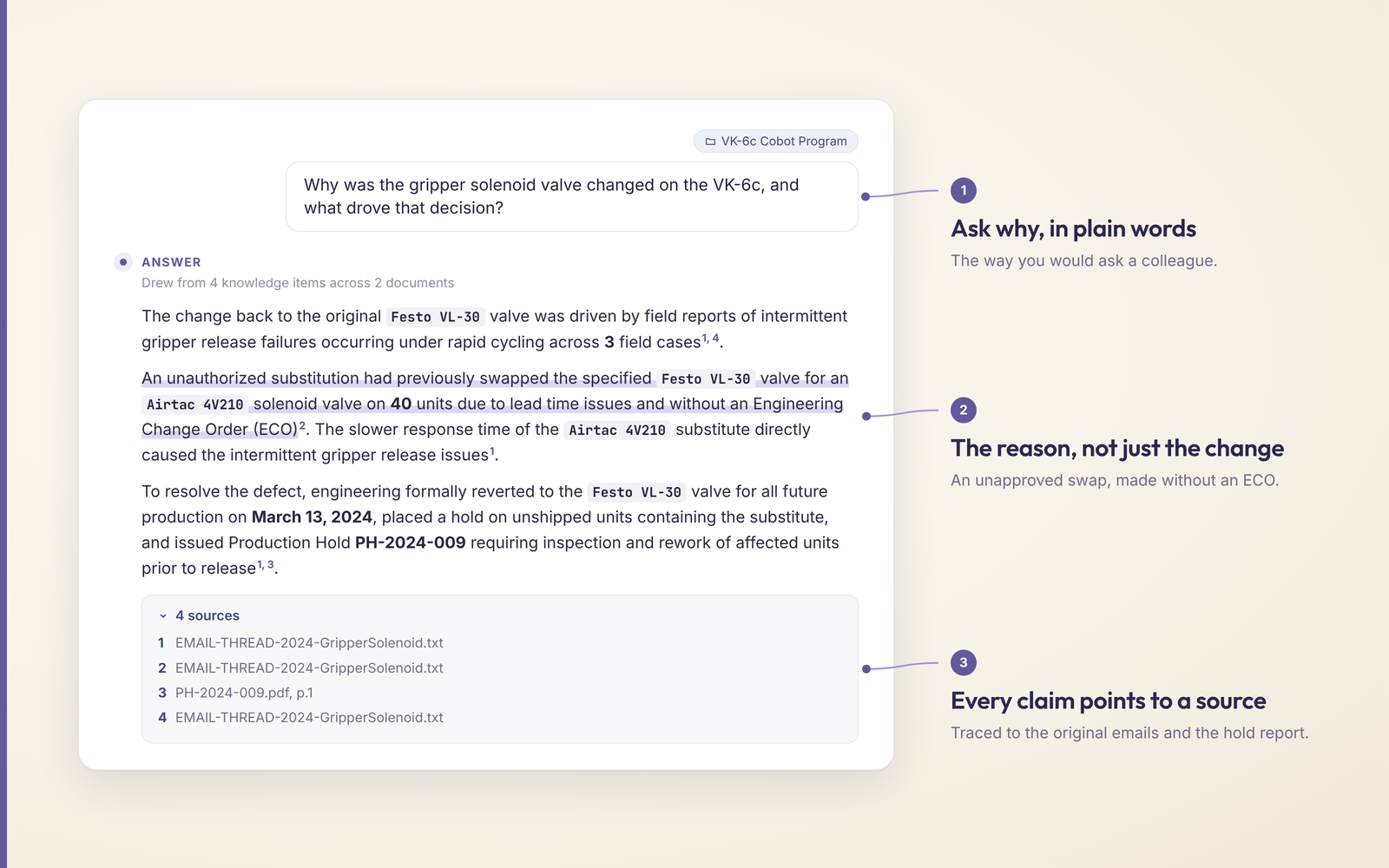
That only works because those documents existed and were handed over. It can't read a reason nobody wrote down, a thread in someone else's inbox, or a conversation at the machine. Most AI tools today work with whatever one person can find and paste in. Every team using them runs into that same limit.
Try this on Tuesday: trace one why
Pick one feature or dimension you've wondered about. Give yourself 30 minutes.
- Write down the part number, the rev and the date it changed.
- Look in four places: the change note, emails from around that date, any test or nonconformance reports, and the person who signed it off.
- If your company has an approved AI tool, give it what you found and ask it to show where each reason comes from.
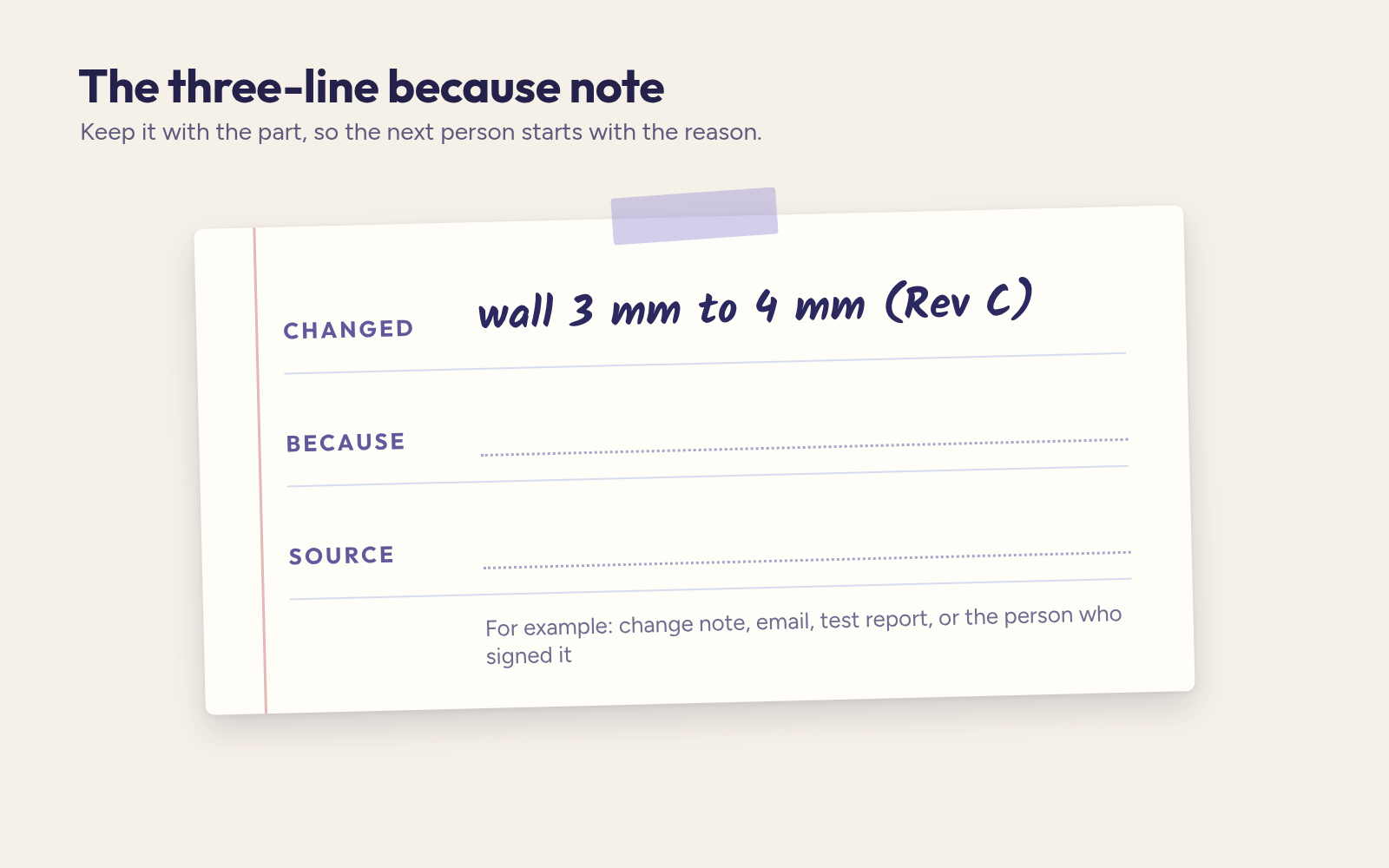
- Write a three-line note and keep it with the part.
The question we all share
If you traced your why, notice how many places it took and who you had to ask. Now picture the next engineer who opens that part in two years.
Everyone asking why is really asking the same thing: what would change if the reason stayed attached to the part? That's where our next post picks up.
Frequently asked questions
What is design intent?
Design intent is the purpose behind a design: what each feature must do and why it is the way it is. It lives in the CAD model, on the drawing, and in the reasons behind each choice.
What is design intent in CAD or SolidWorks?
In CAD tools like SolidWorks or Fusion, design intent usually means building the model so changes behave as expected, using constraints, dimensions and relations. For example, a hole stays centered when the plate gets wider.
What is an example of design intent?
A wall set to 4 mm so a part passes a drop test. A hole kept centered so a mating part always lines up. A material picked because it has to survive a cleaning chemical. Each is a choice with a reason behind it.
What's the difference between tribal knowledge and institutional knowledge?
Both describe know-how that lives in people rather than documents. Tribal knowledge usually means what a small group knows informally. Institutional knowledge is the wider memory of how an organization works. Some teams prefer "institutional knowledge" as the more neutral term.